I read this page and was so impressed with the Water Warriors I have to share this page... These people are encouraging their neighbours to reduce ground run off (rain) going into the main drainage system from paved areas, making it soak into the ground to replenish ground water AND encouraging everyone to pour used kitchen/bathing water onto the soil in their gardens. The result is the ground water has recovered and the water table has gone UP SIX METRES, (wow),
see here; http://www.indiawaterportal.org/articles/water-warriors-chennai . This is a great example of how informal, local water management is having a significant impact on the water table (and ultimately the health of the environment) by bypassing the main water drainage network.
Tuesday, 3 June 2014
Friday, 22 March 2013
Survey replies
Hi, I am posting to say a BIG thank you to people who have read my blog and taken part in the Water Use survey. I have been amazed how many different countries I have had replies from. This is one of those moments when you say to yourself: Wow! The power of the internet is amazing!
this is an image showing where I have had replies from:

Yes, I even had responses from Japan, Australia, Nigeria, this is amazing! Thank you to everyone who has replied, the information you have given is really helpful to me.
this is an image showing where I have had replies from:

Yes, I even had responses from Japan, Australia, Nigeria, this is amazing! Thank you to everyone who has replied, the information you have given is really helpful to me.


Thursday, 24 January 2013
Forget drought -what about flooding?
With the cold winter in England well underway and all the flooding of 2012 just behind us I don't feel like writing about saving water, it is a summer subject, it's hard to get excited about saving water in the winter... or is it? Water saving devices, greywater recycling and rainwater harvesting not only reduce drinking water demand (which is great news in a drought) but also REDUCE the risk of flooding. Hooray! This is because reducing the flow of water in drains increases the spare capacity in the drainage network for coping with sudden surges in rainfall.
This is why the BBC is posting slightly crazy articles like: "Snowmen hold back flood " and why the RSBP are promoting rain gardens. A what? A rain garden is basically a soggy patch in your garden intended to get flooded, full of plants that like a good soaking, sited directly in line with the rainwater downpipe from your roof. This holds water, prolonging the journey time to the drainage network or the nearest river. The more water soaking into the ground, the less water being handled by the drainage network. This is the basic concept behind SUDS or Sustainable Drainage Systems, which reduce water flow rates from car park areas, by providing a road surface that allows water to soak directly into the ground rather than being collected in surface water drainage pipes which take water to a water treatment works. During a flood, the underground drainage network can get overwhelmed with the volume of water running off roads and roofs, causing raw sewage to pour into nearby rivers and canals. If a river busts its banks... no prizes for guessing where the sewage goes next. So if you are worried about flooding:
[1] fit water saving devices, like tap flow restrictors
[2] fit a WATERTWO and use your greywater (see my post on this)
[3] fit a water butt, and use your rainwater (see my post on this)
[4] when it snows -BUILD A SNOWMAN !! But more importantly ...by clearing your driveway and creating a pile of snow on the edge of your lawn you are slowing down the melting process.
[6] get all horticultural and plant yourself a rain garden
[7] maybe skip that swim in the Manchester Ship Canal
for more info on rain gardens
This is why the BBC is posting slightly crazy articles like: "Snowmen hold back flood " and why the RSBP are promoting rain gardens. A what? A rain garden is basically a soggy patch in your garden intended to get flooded, full of plants that like a good soaking, sited directly in line with the rainwater downpipe from your roof. This holds water, prolonging the journey time to the drainage network or the nearest river. The more water soaking into the ground, the less water being handled by the drainage network. This is the basic concept behind SUDS or Sustainable Drainage Systems, which reduce water flow rates from car park areas, by providing a road surface that allows water to soak directly into the ground rather than being collected in surface water drainage pipes which take water to a water treatment works. During a flood, the underground drainage network can get overwhelmed with the volume of water running off roads and roofs, causing raw sewage to pour into nearby rivers and canals. If a river busts its banks... no prizes for guessing where the sewage goes next. So if you are worried about flooding:
[1] fit water saving devices, like tap flow restrictors
[2] fit a WATERTWO and use your greywater (see my post on this)
[3] fit a water butt, and use your rainwater (see my post on this)
[4] when it snows -BUILD A SNOWMAN !! But more importantly ...by clearing your driveway and creating a pile of snow on the edge of your lawn you are slowing down the melting process.
[6] get all horticultural and plant yourself a rain garden
[7] maybe skip that swim in the Manchester Ship Canal
for more info on rain gardens
Monday, 1 October 2012
What's in your shampoo?
http://www.ewg.org/skindeep/product/292915/Softsoap_Body_Wash%2C_Juicy_Pomegranate_and_Mango_Infusions/
The above link is a really interesting database, called EWG, that informs you about what chemicals are in your shampoo, shower gel, creams etc etc and provides informative ratings: 10 being BAD and 1 being GOOD. These ratings help to give you an indication of the ecological impact of your toiletries. Basically the more unpronounceable ingredients in your cleaning product means a higher likelihood of harm to plants, regardless of whether this water ends up in your backyard or the nearest river.
If you want to use greywater recycling, by using laundry or bathwater for watering your garden, remember that natural plant based toiletries or laundry soap will be better for the plants your garden. Washing machines are so fast at spinning, normal laundry may require no washing powder at all! If you think I am joking why don't you try it for yourself?! A warning about crops: do NOT spray plants you are going to eat with greywater but direct water onto the soil so that the soil can act as a natural filter as the water drains down into the ground.

In the Lake District, in Cumbria, North England, there is a campaign called "Love Your Lakes" to encourage people to choose laundry powder that avoids phosphates, as phosphates cause the growth of blue-green algae in lakes like Windermere. Blue-green algae can take over rapidly and destroy habitat for other aquatic plants and animals. Many mainstream laundry powder labels are now getting on board with this and also look out for:
Faith in Nature
Wave by Earth Friendly Products .... see here
Bio-D
For more information on the "Love Your Lakes" campaign see the link below:
http://www.nurturelakeland.org/love-your-lakes/whats-the-problem.html
The above link is a really interesting database, called EWG, that informs you about what chemicals are in your shampoo, shower gel, creams etc etc and provides informative ratings: 10 being BAD and 1 being GOOD. These ratings help to give you an indication of the ecological impact of your toiletries. Basically the more unpronounceable ingredients in your cleaning product means a higher likelihood of harm to plants, regardless of whether this water ends up in your backyard or the nearest river.
If you want to use greywater recycling, by using laundry or bathwater for watering your garden, remember that natural plant based toiletries or laundry soap will be better for the plants your garden. Washing machines are so fast at spinning, normal laundry may require no washing powder at all! If you think I am joking why don't you try it for yourself?! A warning about crops: do NOT spray plants you are going to eat with greywater but direct water onto the soil so that the soil can act as a natural filter as the water drains down into the ground.
In the Lake District, in Cumbria, North England, there is a campaign called "Love Your Lakes" to encourage people to choose laundry powder that avoids phosphates, as phosphates cause the growth of blue-green algae in lakes like Windermere. Blue-green algae can take over rapidly and destroy habitat for other aquatic plants and animals. Many mainstream laundry powder labels are now getting on board with this and also look out for:
Faith in Nature
Wave by Earth Friendly Products .... see here
Bio-D
For more information on the "Love Your Lakes" campaign see the link below:
http://www.nurturelakeland.org/love-your-lakes/whats-the-problem.html
Thursday, 13 September 2012
Water Use Survey
Hello, if you have enjoyed reading my posts on how to make your own rainwater harvesting system or how to save water then please spare a few minutes to answer some questions on water use. I am starting a new business, developing a water saving device and I am interested to know what conditions are like in other countries outside of the UK. Its hard to get up to date information on water use in other countries so I thought I would write my own quick survey -it only has 10 questions. As so many people read this blog from the USA, India, Canada, Australia and beyond I would REALLY appreciate it if you could share this survey with your friends as it would help me to understand the international marketplace for my invention.
Thank you for your help!
Wednesday, 23 May 2012
Water Widgets Review
Free water saving widgets for your bathroom - are they actually useful?

Eaga Shower Smart
The Shower Smart is a type of collar that you fit to your shower hose to restrict the flow of water. It comes in a kit with a plastic bag, which you use to test your shower before you fit the collar. You fill the bag for 5 seconds via the shower head. After this, you need to look at how much water you have collected -if its above the high tide marker on the bag then you should install the Shower Smart. I tested both the shower over the bath and the power shower in the shower cubicle at my house. To my surprise, both of these passed the test, with water in the bag lower that the marker line. The power shower is an aerated type where air is entrained in the shower head to create additional pressure, to feel like a power shower without loads more water being used. The Eaga Shower Smart is only useful to a small number of households as you have to a high flow shower and it can't be an electric shower, and it HAS to be fitted between the tap block and the shower hose. Presumably shower smart can cause faults in electric showers by increasing the resistance in the shower hose. Eaga claim that the Shower Smart will reduce the shower flow rate to 7.7 litres/min.

Littlefoot Water Widget
A rival free product is the Littlefoot Water Widget. Now, I couldn't get this to work properly water, it just sprayed out of the side hole but I think this is because my shower is not sufficiently high pressure to try this out. This is another collar type device that restricts water flow but it is fitted just behind the shower head. This can be fitted to a wall mounted shower or a shower with a hose, although not all wall mounted showers will be adaptable. The Water Widget is also NOT suitable for electric showers and not suitable for low flow showers (they say low flow means anything less than... (yep, you guessed it), 7.7 litre/minute)
I would encourage you to test your shower to see what the flow rate is currently. I suspect more people have a shower that feels a bit pathetic than the impressive power shower type. Electric showers are the box on the wall type. These only have a cold water connection, as the water is heated in the box and forced through the shower head. This box is usually without an internal pump so the showering experience can be a bit dissappointing as it relies on the pressure in the cold water line. This is often the case if you have a cold water tank in the loft, as its the difference in height between the shower head and the tank that really matters, the higher the tank the better. Showers with a mixer tap will be supplied hot and cold water which is accurately mixed by a thermostatic mixer tap to the correct temperature. This type of shower is taking water directly from the hot water system that supplies all the taps. It is this type of shower that the Water Widget is targeting, and will more likely have a higher flow rate than the electric type.
Rate Your Shower
You don't need a silly plastic bag to test your shower, just catch the water in a bucket and time 5 seconds. Pour the water into a measuring jug and note down the millilitres. Repeat this a few times to see if the answers are the same. [click on the diagram to zoom in]

(millilitres x 12) / 1000 = litres/min
7-10 litres/min = OK,
10-14 l/min = too high,
14-30 l/min = power shower zone, way too high!
By fitting the Eaga Shower Smart or Littlefoot Water Widget you will be simply restricting the flow of water, which will mean you use less water per minute but this may mean you have a dissappointing shower experience. Personally, I LOVE a good power shower! If you want to save water without compromising the experience try some of these free products first and if you're not satisfied try out a aerated shower head like Ecocamel . If you are fitting a new bathroom anyway... chose a product like the Hansgrohe Raindance Ecosmart. Hansgrohe claim this reduces the flowrate from 14 l/min to 9 l/min (at 3 bar pressure) without compromising the power shower experience. Look out for the new Ecosmart ratings in the UK, now on showers and taps to help you compare water saving products.

Another couple of free things I got given at the supermarket are the "hippo" and a Littlefoot Flush Bag, these both sit in the WC cistern to reduce the flush volume. These shouldn't be fitted if you have a new 6/4 litre toilet as it will probably not give an effective flush, see my previous post on this . The Hippo is the better product for older 13 litre cisterns as this displaces 2.5-3.5 litres per flush, whereas the Littlefoot only displaces 1.2 litres. You don't really need these products to do this, you can just use some old comestics bottles filled with water to do the same job. Try it!
All in all these products reduce fresh water consumption but do nothing to embrace the water use hierarchy, (see the water hierachy diagram) . They are only scratching the surface of the problem, for example: toilets do not need drinking standard water to flush, this is madness!
for more info on these products, see these links:
Hansgrohe Raindance Ecosmart
Ecocamel aerated shower heads
Littlefoot
the "hippo"
NB: If you have a disappointing shower with a pathetic drip-drip experience, then my advice is to try descaling the shower head. Do this by taking the shower head to bits (unscrew from the hose, and unscrew anything else if it comes apart) and sitting it in a bucket of Coca-cola overnight. If this descaling didn't work, you need to investigate your water pressure, 3 bar is good and anything less than 1 bar is bad news. 0.3 bar is the minimum recommended for a lot of shower heads/outlets, and this is roughly equivalent of 3 metres of vertical drop between your water tank and the shower head, i.e. electric showers on the ground floor with the cold water tank in the loft are always better than electric showers on the first floor. If you can't achieve this, then the only option is to fit a pump.

Eaga Shower Smart
The Shower Smart is a type of collar that you fit to your shower hose to restrict the flow of water. It comes in a kit with a plastic bag, which you use to test your shower before you fit the collar. You fill the bag for 5 seconds via the shower head. After this, you need to look at how much water you have collected -if its above the high tide marker on the bag then you should install the Shower Smart. I tested both the shower over the bath and the power shower in the shower cubicle at my house. To my surprise, both of these passed the test, with water in the bag lower that the marker line. The power shower is an aerated type where air is entrained in the shower head to create additional pressure, to feel like a power shower without loads more water being used. The Eaga Shower Smart is only useful to a small number of households as you have to a high flow shower and it can't be an electric shower, and it HAS to be fitted between the tap block and the shower hose. Presumably shower smart can cause faults in electric showers by increasing the resistance in the shower hose. Eaga claim that the Shower Smart will reduce the shower flow rate to 7.7 litres/min.

Littlefoot Water Widget
A rival free product is the Littlefoot Water Widget. Now, I couldn't get this to work properly water, it just sprayed out of the side hole but I think this is because my shower is not sufficiently high pressure to try this out. This is another collar type device that restricts water flow but it is fitted just behind the shower head. This can be fitted to a wall mounted shower or a shower with a hose, although not all wall mounted showers will be adaptable. The Water Widget is also NOT suitable for electric showers and not suitable for low flow showers (they say low flow means anything less than... (yep, you guessed it), 7.7 litre/minute)
I would encourage you to test your shower to see what the flow rate is currently. I suspect more people have a shower that feels a bit pathetic than the impressive power shower type. Electric showers are the box on the wall type. These only have a cold water connection, as the water is heated in the box and forced through the shower head. This box is usually without an internal pump so the showering experience can be a bit dissappointing as it relies on the pressure in the cold water line. This is often the case if you have a cold water tank in the loft, as its the difference in height between the shower head and the tank that really matters, the higher the tank the better. Showers with a mixer tap will be supplied hot and cold water which is accurately mixed by a thermostatic mixer tap to the correct temperature. This type of shower is taking water directly from the hot water system that supplies all the taps. It is this type of shower that the Water Widget is targeting, and will more likely have a higher flow rate than the electric type.
Rate Your Shower
You don't need a silly plastic bag to test your shower, just catch the water in a bucket and time 5 seconds. Pour the water into a measuring jug and note down the millilitres. Repeat this a few times to see if the answers are the same. [click on the diagram to zoom in]


(millilitres x 12) / 1000 = litres/min
7-10 litres/min = OK,
10-14 l/min = too high,
14-30 l/min = power shower zone, way too high!
By fitting the Eaga Shower Smart or Littlefoot Water Widget you will be simply restricting the flow of water, which will mean you use less water per minute but this may mean you have a dissappointing shower experience. Personally, I LOVE a good power shower! If you want to save water without compromising the experience try some of these free products first and if you're not satisfied try out a aerated shower head like Ecocamel . If you are fitting a new bathroom anyway... chose a product like the Hansgrohe Raindance Ecosmart. Hansgrohe claim this reduces the flowrate from 14 l/min to 9 l/min (at 3 bar pressure) without compromising the power shower experience. Look out for the new Ecosmart ratings in the UK, now on showers and taps to help you compare water saving products.

Another couple of free things I got given at the supermarket are the "hippo" and a Littlefoot Flush Bag, these both sit in the WC cistern to reduce the flush volume. These shouldn't be fitted if you have a new 6/4 litre toilet as it will probably not give an effective flush, see my previous post on this . The Hippo is the better product for older 13 litre cisterns as this displaces 2.5-3.5 litres per flush, whereas the Littlefoot only displaces 1.2 litres. You don't really need these products to do this, you can just use some old comestics bottles filled with water to do the same job. Try it!
All in all these products reduce fresh water consumption but do nothing to embrace the water use hierarchy, (see the water hierachy diagram) . They are only scratching the surface of the problem, for example: toilets do not need drinking standard water to flush, this is madness!
for more info on these products, see these links:
Hansgrohe Raindance Ecosmart
Ecocamel aerated shower heads
Littlefoot
the "hippo"
NB: If you have a disappointing shower with a pathetic drip-drip experience, then my advice is to try descaling the shower head. Do this by taking the shower head to bits (unscrew from the hose, and unscrew anything else if it comes apart) and sitting it in a bucket of Coca-cola overnight. If this descaling didn't work, you need to investigate your water pressure, 3 bar is good and anything less than 1 bar is bad news. 0.3 bar is the minimum recommended for a lot of shower heads/outlets, and this is roughly equivalent of 3 metres of vertical drop between your water tank and the shower head, i.e. electric showers on the ground floor with the cold water tank in the loft are always better than electric showers on the first floor. If you can't achieve this, then the only option is to fit a pump.
Thursday, 22 March 2012
Run your washing machine on rainwater

For World Water Day I am going to explain how to connect your washing machine to a rainwater tank, (see my previous post on how to set up a rainwater tank). WHY do this? Answer = because your washing machine needs about 50 litres of water (5 buckets) for every load, this water does need to be clean but it does NOT need to be drinking water standard. Providing rainwater is filtered correctly this is safe to use in your washing machine. In order to connect a washing machine to a rainwater tank, to make use of rain for washing clothes, a few things need to be considered first:
[1] Your washing machine is expecting water to be available at normal main network water pressure. If the water pressure is too low or the flow of water is too sluggish then the machine may fail to start. This can happen if your tank is too far away or the tank is nearly empty. This normal pressure varies widely, it depends where you live in relation to the network pumping station. In the UK it is commonly 1 to 3.5 bar, although it can be up to 10 bar. In continental Europe, water pressure above 3.5 bar is more common. Now you're thinking -what is 3.5 bar anyway? -this is the same pressure you get from a tap that takes water from a tank 35 m higher than the tap (1 bar = 10 metre head height between the tank level and the tap). So if you have a very hilly site you can get creative to achieve this, but for everyone, else a pump is required.
[2] The machine is intended to handle mains network water. This is high quality, drinking standard water. However it is perfectly safe for rainwater to be used as a substitute for washing clothes providing that air pollution is not a major problem (acid rain and smog are no longer a problem in the UK) -and- that the collected water is well filtered to remove debris.
So in order to get water from your rainwater storage tank to the washing machine, you will probably need a pump. (The exception to this is if the tank is higher than the washing machine, e.g. your tank is on the ground floor and your washing machine is in the basement.) I recommend using a power shower booster pump for this purpose as these are already fitted with a pressure sensor.

The pump will automatically switch on when the washing machine starts and automatically switch off when the washing machine stops drawing water. This should provide adequate pressure to ensure the water flow reaches the washing machine. (The more bends and connections and the smaller the pipe diameter and the higher the washing machine, all increase the work load or pressure head demand on the pump).
These shower pumps (like this one) are connected to the supply lines normally for both hot and cold connections. You will need to join the two inlets together so that they both accept cold rainwater. The same will need to be done to the two outlet lines, to create one out-going line.
(Click and zoom to see my sketch of the whole setup more clearly...)


The rainwater tank should include mesh filters to remove debris and an auto mains refill float valve (see my previous post on this). It is also possible to collect the drainage water expelled from the washing machine if you live in a particularly drought prone area (like England! Yes we are in drought right now). You can use this to:
[a] water the garden -make sure you use biodegradable laundry soap! I recommend soda crystals or ECOballs. Actually you can get away WITHOUT using washing powder at all with a normal load. Modern machines are so good, the spinning action is the main thing that cleans the clothes. This really is the greenest option. Maybe save the laundry powder for just sports kit? Don't water crops directly with the waste water, make sure you direct the water onto the soil only and vary which part of the garden you water. If your plants start to look worse then use the no soap option.
[b] reuse water from the second wash or rinse cycle to feed back into the first cycle of a second laundry load. This involves manually setting up a bucket to collect drainage water and manually pouring this into the rainwater storage tank for reuse. You will need to time the washing machine to work out how long this takes to finish each cycle, to get the hang of this.
Most washing machines are designed to pump drainage water back up to worktop height to ensure the drainage water is properlly expelled from the machine, therefore the drain pipeline does not have to be right down at floor level to do its job. Fitting a WATER TWO drainage valve in the drainage pipeline from the washing machine can be really useful for both of the above tasks, to avoid the need to lift the flexible drainage hose out of the fixed drainage pipe and risk water spilling everywhere whilst you direct it into the bucket. It's OK to arrange the drainage line so that there is enough room to fit a bucket underneath the drainage pipe next to the washing machine with a T junction.
Monday, 12 March 2012
WaterAid Triathlon Update
My online sponsorship total is up to the £200 mark now after some "facebook" action, I am delighted. If you haven't voted already check out the campaign for tasteful triathlon attire on my triathlon page on facebook. If you too feel that more tasteful attire is needed in the world of triathlon feel free to vote for your favourite outfit. click here to vote
WaterAid is a very worthy charity. They give support to improve sanitation in many areas of the world, including helping victims of the recent Cyclone Giovanna in Madagascar. The cyclone has destroyed over 90% of latrines, due to heavy floodwater. WaterAid are working on the ground, trying to improve access to clean water for drinking and safe access to temporary toilets to prevent the spread of water borne diseases.

WaterAid is a very worthy charity. They give support to improve sanitation in many areas of the world, including helping victims of the recent Cyclone Giovanna in Madagascar. The cyclone has destroyed over 90% of latrines, due to heavy floodwater. WaterAid are working on the ground, trying to improve access to clean water for drinking and safe access to temporary toilets to prevent the spread of water borne diseases.
Tuesday, 21 February 2012
Drought Summit
We get plenty of rain, so what's the problem? Drought Summit as Rivers in England Dry Up
Yesterday, Caroline Spelman, Environment Secretary , hosted a Drought Summit to discuss the impending water shortage over the next 6 months for the South East, East Anglia and the East Midlands. The meeting involved stakeholders such as farmers, wildlife groups and water companies, to discuss solutions. This is the current situation:
Areas OFFICIALLY IN DROUGHT, by county:
Lincolnshire
Cambridgeshire
Hampshire
West Sussex
East Sussex
Kent
London
Surrey
Berkshire
Hertfordshire
Buckinghamshire
Oxfordshire

Ms Spelman, in an interview with BBC Radio 4, was asked "what can we do to save water, get water meters?" she replied "Water meters can be helpful, particularly for households with a small number of occupants or a reduced income. But the most important thing is to save water. Everybody knows how to save water."
In my opinion this is a short sighted approach from the Environment Secretary. Two-thirds of all water consumption in the UK is from households. Consumers have to be motivated to use less water. Water meters make people realise how much water they are using and also allow people to pay for exactly what they use. This means consumers will be motivated by spending less as well as a moral concern about environmental impact.
In the same way that counting calories helps overweight people eat less, reading the water meter will give people a better awareness of how much water they use each month in comparison to other households and benchmarks.
In the UK we have a perception that drought doesn't happen here, it doesn't affect us, as the UK is a cold and wet country. We get plenty of rain, so what's the problem? The real underlying problem is human population. There is a dense, urban population in the UK, particularly in the South East, creating a huge water demand. Looking back at the last 100 years, UK population has increased from 38 million in 1900 to 59 million in 2000, this staggering 55% increase or extra 21 million people, are putting pressure on the water companies to over-abstract water from all fresh water sources. This has already caused long term damage to the environment and wildlife with significant loss of animal and plant species, particularly for wetland and river habitats.

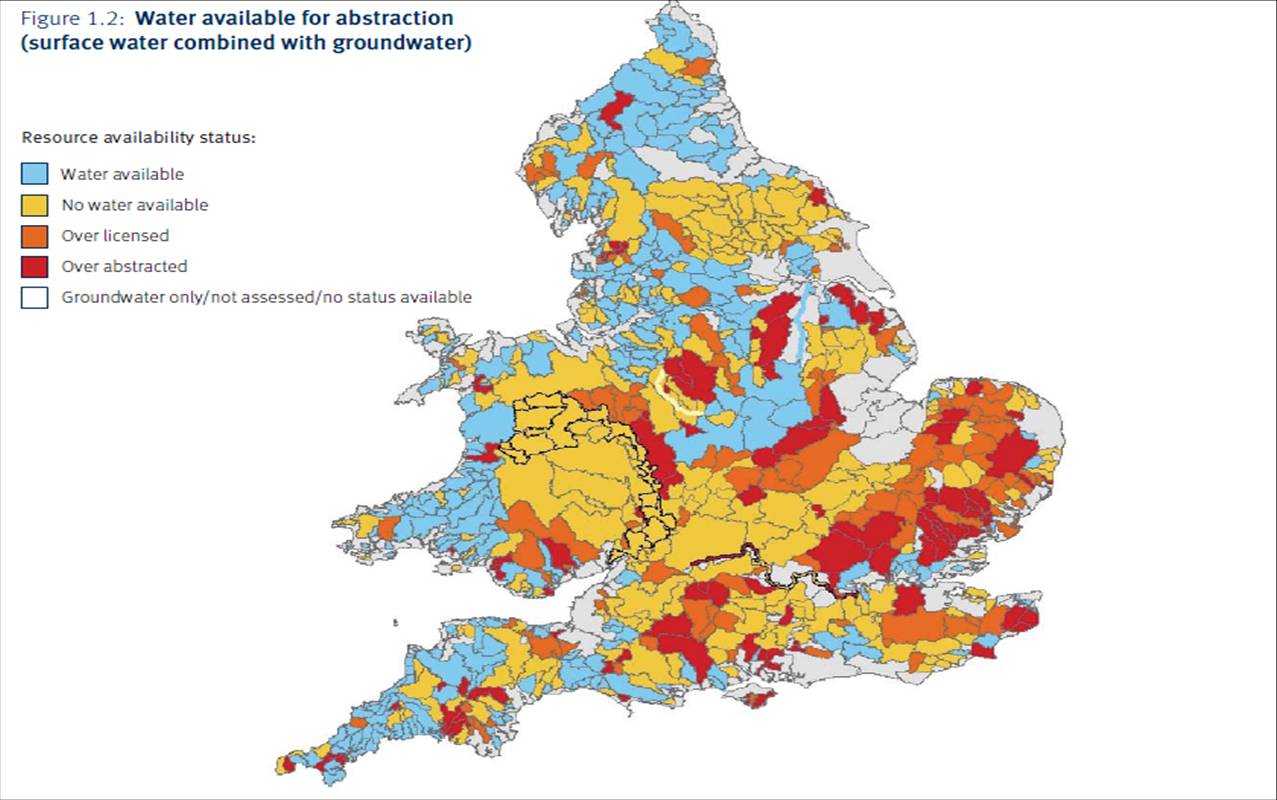
From the map below (click on the image to zoom in) you can see how the work of water companies impacts on freshwater resources. There are many areas with no spare capacity (orange to red areas) and many areas are seriously over abstracted (red areas) which harms the local ecology. Almost every inch of the country is being used to collect ground water to serve the public water network.

Unfortunately UK consumers are in a weak position to react to this drought warning for the following reasons:
- fixed tariffs, often set annual, no penalty for high water use
- water meters are not mandatory, most people have no idea how much water they use
- few water saving products available that offer real savings
- prohibitively high cost of installing rainwater recovery systems
I see the only way to curb this demand in the short term is to motivate households to save water e.g. by making water meters mandatory, promoting the use of water butts for gardening, higher tariffs for excessive water use. There are many ways to reduce water consumption but most people are not motivated to do this currently as the perceived consequences of carrying on as normal are nil. In the long term the government will need to reduce UK population to a sustainable level that puts less strain on the available water resources.
Yesterday, Caroline Spelman, Environment Secretary , hosted a Drought Summit to discuss the impending water shortage over the next 6 months for the South East, East Anglia and the East Midlands. The meeting involved stakeholders such as farmers, wildlife groups and water companies, to discuss solutions. This is the current situation:
Areas OFFICIALLY IN DROUGHT, by county:
Lincolnshire
Cambridgeshire
Hampshire
West Sussex
East Sussex
Kent
London
Surrey
Berkshire
Hertfordshire
Buckinghamshire
Oxfordshire

Ms Spelman, in an interview with BBC Radio 4, was asked "what can we do to save water, get water meters?" she replied "Water meters can be helpful, particularly for households with a small number of occupants or a reduced income. But the most important thing is to save water. Everybody knows how to save water."
In my opinion this is a short sighted approach from the Environment Secretary. Two-thirds of all water consumption in the UK is from households. Consumers have to be motivated to use less water. Water meters make people realise how much water they are using and also allow people to pay for exactly what they use. This means consumers will be motivated by spending less as well as a moral concern about environmental impact.
In the same way that counting calories helps overweight people eat less, reading the water meter will give people a better awareness of how much water they use each month in comparison to other households and benchmarks.
In the UK we have a perception that drought doesn't happen here, it doesn't affect us, as the UK is a cold and wet country. We get plenty of rain, so what's the problem? The real underlying problem is human population. There is a dense, urban population in the UK, particularly in the South East, creating a huge water demand. Looking back at the last 100 years, UK population has increased from 38 million in 1900 to 59 million in 2000, this staggering 55% increase or extra 21 million people, are putting pressure on the water companies to over-abstract water from all fresh water sources. This has already caused long term damage to the environment and wildlife with significant loss of animal and plant species, particularly for wetland and river habitats.

From the map below (click on the image to zoom in) you can see how the work of water companies impacts on freshwater resources. There are many areas with no spare capacity (orange to red areas) and many areas are seriously over abstracted (red areas) which harms the local ecology. Almost every inch of the country is being used to collect ground water to serve the public water network.
Unfortunately UK consumers are in a weak position to react to this drought warning for the following reasons:
- fixed tariffs, often set annual, no penalty for high water use
- water meters are not mandatory, most people have no idea how much water they use
- few water saving products available that offer real savings
- prohibitively high cost of installing rainwater recovery systems
I see the only way to curb this demand in the short term is to motivate households to save water e.g. by making water meters mandatory, promoting the use of water butts for gardening, higher tariffs for excessive water use. There are many ways to reduce water consumption but most people are not motivated to do this currently as the perceived consequences of carrying on as normal are nil. In the long term the government will need to reduce UK population to a sustainable level that puts less strain on the available water resources.
Thursday, 9 February 2012
WaterAid update
.

I am now up to £110 with sponsorship money for my triathlon. Recent training for the event has involved 2 days of ice climbing in Scotland and a 23km walk in the snow from Altrincham to Tatton Park and back. I was glad Tatton Park were open when we got there, it was freezing, it was also great to see the herd of deer sitting in the snow. If you want to support WaterAid please go to my sponsorship webpage, overseas donations are accepted. click here to donate
WaterAid is an international non governmental organisation focused exclusively on improving poor people’s access to safe water, improved hygiene and sanitation. WaterAid works in Africa, Asia and the Pacific region and campaigns globally to realise a vision of a world where everyone has access to these basic human needs.
Please help me to work towards a world where everyone can have access to clean, safe water
Just £15 can give the life changing gift of clean water to one person. See what else your donation could provide:
• £12 can buy two taps for a village waterpoint
• £15 can give the gift of water to one whole person
• £20 can buy 25 metres of pipe
• £46 can buy a family toilet
• £50 can buy a handpump
• £60 can buy a rainwater collection jar
• £100 can buy a soap making business for two people
So please, dig deep and help me hit my target!
If you feel like joining me in my challenge for WaterAid, email events@wateraid.org for more information.

I am now up to £110 with sponsorship money for my triathlon. Recent training for the event has involved 2 days of ice climbing in Scotland and a 23km walk in the snow from Altrincham to Tatton Park and back. I was glad Tatton Park were open when we got there, it was freezing, it was also great to see the herd of deer sitting in the snow. If you want to support WaterAid please go to my sponsorship webpage, overseas donations are accepted. click here to donate
WaterAid is an international non governmental organisation focused exclusively on improving poor people’s access to safe water, improved hygiene and sanitation. WaterAid works in Africa, Asia and the Pacific region and campaigns globally to realise a vision of a world where everyone has access to these basic human needs.
Please help me to work towards a world where everyone can have access to clean, safe water
Just £15 can give the life changing gift of clean water to one person. See what else your donation could provide:
• £12 can buy two taps for a village waterpoint
• £15 can give the gift of water to one whole person
• £20 can buy 25 metres of pipe
• £46 can buy a family toilet
• £50 can buy a handpump
• £60 can buy a rainwater collection jar
• £100 can buy a soap making business for two people
So please, dig deep and help me hit my target!
If you feel like joining me in my challenge for WaterAid, email events@wateraid.org for more information.
Thursday, 29 December 2011
WaterAid
The ball is rolling for WaterAid! The first person has sponsored me in the Cheshire Triathlon. The triathlon is on the 27th May 2012 and I am raising awareness for WaterAid a very worthy charity which provides better sanitation for people all over the world. Poor sanitation kills more people each year than AIDS measles and malaria put together. Simple measures can be put in place to improve sanitation like providng water pumps. WaterAid improves water quality, safeguards water resources for farming and enables more (fit and health) children to attend school. Click here to see what WaterAid do
Please have a look at my sponsorship page to make a donation here The triathlon is a standard sprint distance: swim, bike then run.
Please have a look at my sponsorship page to make a donation here The triathlon is a standard sprint distance: swim, bike then run.
Friday, 1 July 2011
Climate Change and Domestic Energy Use
My research article on climate change effects on UK domestic energy consumption was the most popular download from all 2009 and 2010 articles at the BSERT journal! The article discusses the switch to air conditioning in housing due to global warming. To celebrate, the BSERT journal have allowed a free full text version to be downloadable. Click on the link below to read on:
my article in full text

my article in full text

Tuesday, 22 March 2011
A homemade rainwater harvesting system

As it's World Water Day, following on from my last post about collecting rainwater ... this post is all about fitting a homemade rainwater harvesting system. I recommend using a blue barrel with a clamp on lid as a storage tank as the clamp will come in handy to fit the water filters. (but you can use any tank you like, appropriate to the level of rainfall you are expecting to store). Note that storing water for a long time may give you problems due to the attraction of bugs and bacteria (particularly for hotter countries). You may wish to dose your water with chemicals to avoid this. See the following image, click and zoom for details.

heres some pictures of that blue barrel I recommend, these are popular with canoeists:


Note that I say "adapted" fresh water inlet valve, this means you will have to adjust the float arm length or position until you are happy that it refills with normal water to the right minimum level. Something like THIS plus a ball float valve. You may have to extend the arm, use a brass or plastic rod for this, something that won't rust or decay underwater.
Power shower PUMP --you need something that will provide some pressure to deliver water towards the washing machine, particularly when the rainwater tank is nearly empty.

To collect rainwater from the roof, note that the water will swirl around on the inner surface of the rainwater down pipe from the roof. Therefore for capturing this, an inner edge that encourages water towards the opening mouth of your feeder tube (towards the storage tank) can increase the efficiency of collection. Also it is a good idea to have an overflow pipe flowing down at an angle from near the top of the storage tank, back to the rainwater down pipe. This stops excess water going over the top

.
Water draining away from the washing machine could be collected for reuse -but I'll save that for a separate post.....now available - click here
Friday, 18 March 2011
Collecting rainwater
If you want to collect rainwater and start using it, you should first consider how big the tank should be. This depends on how much you can collect and how much you need. Rainwater is absolutely safe to use for watering your garden and washing your car, and if filtered correctly it can be used to run your washing machine. (See my other articles on how to make a rainwater harvesting system and how to connect this to your washing mashine)
HOW MUCH CAN YOU COLLECT?
To work out how much you can collect, you have to think about how often it rains and how much rain arrives. I live in Manchester, UK, where it's fair to say it rains every 3 days, or we have that kind of reputation anyway! If you live somewhere hot and dry you may have problems with infrequent rain, which, when it does arrive there is so much you hate it and then, all of a sudden, it's gone again and you are back to hot and dry weather. Anyway, you know about where you live so you know best. However, you can look up the rainfall from a local weather station which will give rainfall typically data is millimetres of rain, collected monthly. Now millimetres means just that, the depth of the rainfall, rain falls every where equally so if you have a small cup or a large bucket, you will collect the same number of millimetres, depth of water. The volume of water you collect depends on the AREA of the cup, or the bucket, or the pond or the roof etc. etc. Normally, you can easily get your hands on mean i.e. typical monthly rainfall in millimetres. Try websites like WUNDERGROUND for this. The following graph is for Edinburgh, Scotland -which like Manchester, England, gets frequent rainfall throughout the year. (Click and zoom for a closer look...)

HOW BIG IS YOUR ROOF?
The best way to collect rainwater from a large area is to use the roof of your house. It doesn't matter whether it's a pitched roof with an apex or a flat roof, the pitched roof will not collect anymore water than the flat roof, providing you have a gutter or drainage channel to retrieve the water, and your roof is relatively clean, then, you're in business. If you know the width and length of the roof in metres you can work out how much water you can collect in a month, in the following way:
mm rainfall divided by 1000
x width (metres) x length (metres)
and divide the total by 1000, this is how many litres of water you can collect in a month.
Water Demand = number of litres a month you will use up.
Providing rainwater is filtered, it can be used for laundry. Laundry - 65 litres per load is a good guess for a front loading European style machine.
Rainwater can be used to flush the toilet, this requires some plumbing work to pump the water to the cistern -it will not fill if the supply has no pressure. Water use for toilet flushing -a good guess is 5 flushes per person per day living at home. What type of cistern have you got? 6 litres, 9 litres, 13 litres? see this POST for help
Calculate: cistern size (litres) x no.of people x 5 flushes per day.
Gardening - this could be anything, depends on your passion for gardening!
Add up all you figures for demand from gardening/laundry/toilets.
Compare your demand figure to your litres of rainfall. Ideally you want these figures to be equal, to collect as much as you want to use. If the rainfall is higher then this is not a problem, but if the demand is more then you could try increasing the size of the tank, or looking for another roof to take water from, or reduce your demand somehow. Also remember that water demand for gardening will be seasonal.
To get the right size tank you have to consider another factor -frequency of rainfall, this just goes on your judgement and any detailed rainfall data you can get your hands on of course! In the UK, as it rains so frequently, a 14 day storage is advisable, so that if an enormous deluge of rain occurred and then it was dry for the next 2 weeks you would be able to "ride the wave" between supply and demand. How do you check this -calculate:
14 x daily demand for gardening/laundry/toilet flushing = tank size
Now if you live in Australia, for example, you may find a much, much larger store (storage for 8 weeks or more) is necessary to make your project worthwhile.
VH87G87C7HS6
HOW MUCH CAN YOU COLLECT?
To work out how much you can collect, you have to think about how often it rains and how much rain arrives. I live in Manchester, UK, where it's fair to say it rains every 3 days, or we have that kind of reputation anyway! If you live somewhere hot and dry you may have problems with infrequent rain, which, when it does arrive there is so much you hate it and then, all of a sudden, it's gone again and you are back to hot and dry weather. Anyway, you know about where you live so you know best. However, you can look up the rainfall from a local weather station which will give rainfall typically data is millimetres of rain, collected monthly. Now millimetres means just that, the depth of the rainfall, rain falls every where equally so if you have a small cup or a large bucket, you will collect the same number of millimetres, depth of water. The volume of water you collect depends on the AREA of the cup, or the bucket, or the pond or the roof etc. etc. Normally, you can easily get your hands on mean i.e. typical monthly rainfall in millimetres. Try websites like WUNDERGROUND for this. The following graph is for Edinburgh, Scotland -which like Manchester, England, gets frequent rainfall throughout the year. (Click and zoom for a closer look...)

HOW BIG IS YOUR ROOF?
The best way to collect rainwater from a large area is to use the roof of your house. It doesn't matter whether it's a pitched roof with an apex or a flat roof, the pitched roof will not collect anymore water than the flat roof, providing you have a gutter or drainage channel to retrieve the water, and your roof is relatively clean, then, you're in business. If you know the width and length of the roof in metres you can work out how much water you can collect in a month, in the following way:
mm rainfall divided by 1000
x width (metres) x length (metres)
and divide the total by 1000, this is how many litres of water you can collect in a month.
Water Demand = number of litres a month you will use up.
Providing rainwater is filtered, it can be used for laundry. Laundry - 65 litres per load is a good guess for a front loading European style machine.
Rainwater can be used to flush the toilet, this requires some plumbing work to pump the water to the cistern -it will not fill if the supply has no pressure. Water use for toilet flushing -a good guess is 5 flushes per person per day living at home. What type of cistern have you got? 6 litres, 9 litres, 13 litres? see this POST for help
Calculate: cistern size (litres) x no.of people x 5 flushes per day.
Gardening - this could be anything, depends on your passion for gardening!
Add up all you figures for demand from gardening/laundry/toilets.
Compare your demand figure to your litres of rainfall. Ideally you want these figures to be equal, to collect as much as you want to use. If the rainfall is higher then this is not a problem, but if the demand is more then you could try increasing the size of the tank, or looking for another roof to take water from, or reduce your demand somehow. Also remember that water demand for gardening will be seasonal.
To get the right size tank you have to consider another factor -frequency of rainfall, this just goes on your judgement and any detailed rainfall data you can get your hands on of course! In the UK, as it rains so frequently, a 14 day storage is advisable, so that if an enormous deluge of rain occurred and then it was dry for the next 2 weeks you would be able to "ride the wave" between supply and demand. How do you check this -calculate:
14 x daily demand for gardening/laundry/toilet flushing = tank size
Now if you live in Australia, for example, you may find a much, much larger store (storage for 8 weeks or more) is necessary to make your project worthwhile.
VH87G87C7HS6
Tuesday, 15 February 2011
THE WATER TREATMENT CYCLE
See this great animated tour of the water cycle by Yorkshire Water and see what happens to create fresh water. Treating water to this high standard takes a lot of energy to pump water from A to B, the waste water treatment and for the cleaning of fresh water taken from rivers and reservoirs. It has been estimated that for each 1000 litres of water arriving at your tap this requires 2.2 kWh of electricity to treat. If your water comes from a desalination plant which convert salty sea water into fresh water this requires a further 1.5 to 2.5 kWh to process, depending on how efficiency the plant is.
And shock horror! News just in .... according to the Guardian 39 million tonnes of "sewage" goes into the river Thames, in London, every year! Now that's gross! The fact remains is that many EU countries pay fines rather than fixing the problem of pumping sewage into rivers or the sea. Most rivers in the UK are over abstracted -i.e. the water companies are regularly taking too much water out of the river and this harms the river ecology.
Any greywater you can divert directly onto your garden, rather than down the drain, cuts out this long cycle of man made treatment and delivery. Water that goes into the ground will be filtered naturally and eventually end up in the sea and evapourate and return as RAIN. Likewise any water you can collect as rain also interrupts this cycle. In areas where acid rain is not a problem and air pollution is closely regulated, rain can be a relatively clean source. Obviously, you must be careful what kind of water you use like this -see my diagram of the WATER USE HIERARCHY
Next time -I'll be blogging about water butts and rain water in preparation for world water day...

And shock horror! News just in .... according to the Guardian 39 million tonnes of "sewage" goes into the river Thames, in London, every year! Now that's gross! The fact remains is that many EU countries pay fines rather than fixing the problem of pumping sewage into rivers or the sea. Most rivers in the UK are over abstracted -i.e. the water companies are regularly taking too much water out of the river and this harms the river ecology.
Any greywater you can divert directly onto your garden, rather than down the drain, cuts out this long cycle of man made treatment and delivery. Water that goes into the ground will be filtered naturally and eventually end up in the sea and evapourate and return as RAIN. Likewise any water you can collect as rain also interrupts this cycle. In areas where acid rain is not a problem and air pollution is closely regulated, rain can be a relatively clean source. Obviously, you must be careful what kind of water you use like this -see my diagram of the WATER USE HIERARCHY
Next time -I'll be blogging about water butts and rain water in preparation for world water day...

Saturday, 20 November 2010
BIODEGRADABLE SOAP

It's important to use biodegradable soap & cleaning products when you are re-using your bathwater to water the garden, as normal soap takes a long time to break down from complex chemicals into more useful simple substances that plant life can absorb. So I thought I would write something on biodegrable soap...first of all, look out for vegetable based solid soap like Marseille soap or glycerin soap. Glycerin soap is usually translucent. Marseille soap uses olive oil as a base.
If you prefer to use liquid soap or shower gel, rather than solid soap, you can make your own shower gel by:
[1] grating solid soap into flakes
[2] putting these into an old shower gel bottle with some hot water
[3] Shake the bottle for a few minutes and leave it to stand for a day or too.

This is then ready to use. This is also good for the environment because it stops you buying shower gel bottles which then have to be recycled or just thrown away, ending up in landfill. If you can't be bothered with that, you could use solid soap in the shower, if you have somewhere to put it... you can put in on a string and hang it up above the bath. The best way to do this is to use a screwdriver to grind a hole by hand through the centre of the bar of soap and thread some thick cord through this. Its best to hang the soap high up so its not in the water stream, this way it will last longer.
CHOOSING CLEANING PRODUCTS
As for biodegradeable cleaning products to clean your bath, try using soda crystals or borax. You can buy these sorts of products in cardboard boxes (again less plastic waste) from Clean and Natural by DRI PAK. If you scrub this powder onto the surface of the bath with a bit of water and leave it for a while before washing it off again, it is pretty effortless -on a par with stronger household cleaning products but with less ecological impact. These products are easy and safe to use and odourless. Soda crystals are produced by a relatively simple chemical process which means its more easily broken down, unlike phosphates which are found in more modern cleaning products. for more information on this subject see this page on toxic water by Surfers Against Sewage (SAS)
Friday, 12 November 2010
RECYCLING YOUR BATH WATER WITH WATER TWO
Hello again!
I wanted to talk about the WATER TWO and dispell a few myths about drainage and what happens when water goes down the plug hole. All water from the kitchen sink, the bath, a wash hand basin, the shower, goes down a pipe into the sewer. All drainage or waste pipes should have a U bend where water collects, to stop bad smells rising up the tube and filling the house, but beyond the U bend or "trap" the tube will be empty, most of the time. If you were able to look inside a drainage tube around your house, it would probably be empty -it is not full of dirty water all the time like the sewer underground -it is usually empty until someone.... lets the plug out the bath, or the sink, or runs the washing machine.
If you go to a hardware store you can buy straight lengths of drainage tube and bends but not valves as normally there is no need to have a valve.... however, if you are keen to save water a valve is very useful to divert greywater to recycle it for other uses like watering your plants.

A company in the UK sells drainage water valves called WATER TWO -this neat device lets you divert water from your bath for use in the garden. You attach it to the down pipe directly from the bath -this relatively clean water can be recycled to be used in the garden. When you take a bath leave the plug in. Go outside turn the WATER TWO valve to divert, then pull the plug out the bath and open the spray on your garden hose to start watering all those thirsty flowers.
This is one of the pathways identified in my previous post on the water use hierarchy. This is a great way to water your garden at no extra cost and you can fit it without getting wet! This also lengthens the pathway of the water between water treatment cycles as water will naturally be filtered by the plants before ending up in the atmosphere or travelling to the nearest river or water course. This means by the time the water reaches a water treatment plant (via a river or lake) to be converted into drinking water, it is already quite clean.
A bath uses up to 80 litres of water and if you have a shower over the bath, using shower to collect water, this might collect 40 litres of water. Bathing uses roughly 30% of all household water and provides a regular and reliable source of water for your garden, unlike rain!

If you are keen to start using a WATER TWO diverting valve then you must use it responsibly, remember that bathwater is not as clean as water direct from the tap:
Don't store this water in a barrel. Over time, e.g 1 or 2 days or more, microorganisms like bacteria will multiply and you want to avoid this as you will come into contact with this bacteria as you water your garden.
Don't spray plants directly, water the soil.
Don't water plants that you are going to eat, e.g. lettuces.
Do use environmentally friendly soap. Products with low salt (Sodium Chloride), Boron and Phosphates are better. Avoid using bathwater that contains bleach or other household cleaning products, these chemicals will not be good for your garden.
Don't use the WATER TWO system if someone in your household has an infectious disease or diarrhoea, because watering your garden could increase the risk of other people becoming ill.
Greywater tends to be a bit alkaline, so flowers like Azaleas which prefer acid conditions don't grow well with this type of watering. Clay soils have low permeability so can't absorb water easily and may not cope with absorbing the salt found in greywater. Keep an eye on your plants, if they look weakened by greywater, alternate use with normal watering from the tap and water different parts of your garden to spread out the exposure to greywater.
Once you have watered your garden, remember to wash your hands before you eat!
I wanted to talk about the WATER TWO and dispell a few myths about drainage and what happens when water goes down the plug hole. All water from the kitchen sink, the bath, a wash hand basin, the shower, goes down a pipe into the sewer. All drainage or waste pipes should have a U bend where water collects, to stop bad smells rising up the tube and filling the house, but beyond the U bend or "trap" the tube will be empty, most of the time. If you were able to look inside a drainage tube around your house, it would probably be empty -it is not full of dirty water all the time like the sewer underground -it is usually empty until someone.... lets the plug out the bath, or the sink, or runs the washing machine.
If you go to a hardware store you can buy straight lengths of drainage tube and bends but not valves as normally there is no need to have a valve.... however, if you are keen to save water a valve is very useful to divert greywater to recycle it for other uses like watering your plants.

A company in the UK sells drainage water valves called WATER TWO -this neat device lets you divert water from your bath for use in the garden. You attach it to the down pipe directly from the bath -this relatively clean water can be recycled to be used in the garden. When you take a bath leave the plug in. Go outside turn the WATER TWO valve to divert, then pull the plug out the bath and open the spray on your garden hose to start watering all those thirsty flowers.
This is one of the pathways identified in my previous post on the water use hierarchy. This is a great way to water your garden at no extra cost and you can fit it without getting wet! This also lengthens the pathway of the water between water treatment cycles as water will naturally be filtered by the plants before ending up in the atmosphere or travelling to the nearest river or water course. This means by the time the water reaches a water treatment plant (via a river or lake) to be converted into drinking water, it is already quite clean.
A bath uses up to 80 litres of water and if you have a shower over the bath, using shower to collect water, this might collect 40 litres of water. Bathing uses roughly 30% of all household water and provides a regular and reliable source of water for your garden, unlike rain!

If you are keen to start using a WATER TWO diverting valve then you must use it responsibly, remember that bathwater is not as clean as water direct from the tap:
Don't store this water in a barrel. Over time, e.g 1 or 2 days or more, microorganisms like bacteria will multiply and you want to avoid this as you will come into contact with this bacteria as you water your garden.
Don't spray plants directly, water the soil.
Don't water plants that you are going to eat, e.g. lettuces.
Do use environmentally friendly soap. Products with low salt (Sodium Chloride), Boron and Phosphates are better. Avoid using bathwater that contains bleach or other household cleaning products, these chemicals will not be good for your garden.
Don't use the WATER TWO system if someone in your household has an infectious disease or diarrhoea, because watering your garden could increase the risk of other people becoming ill.
Greywater tends to be a bit alkaline, so flowers like Azaleas which prefer acid conditions don't grow well with this type of watering. Clay soils have low permeability so can't absorb water easily and may not cope with absorbing the salt found in greywater. Keep an eye on your plants, if they look weakened by greywater, alternate use with normal watering from the tap and water different parts of your garden to spread out the exposure to greywater.
Once you have watered your garden, remember to wash your hands before you eat!
Wednesday, 20 October 2010

Friday, 15 October 2010
START SAVING WATER TODAY FOR B.A.D
as part of BLOG ACTION DAY [blogactionday.change.org] -or- BAD ! I will be showing you how to make some simple steps towards using less water around your home.
How to use less water to flush the toilet - a quick resolution you can start using today....
If you have an old 13, 11, 9 or 7.5 litre WC consider fitting a water dispacement device inside your toilet cistern to reduce the volume of water flushed down the toilet every time you flush. 6 litre toilets were being fitted from 2001 in the UK to comply with new water regulations -this advice is not for a 6 litre or less system -its for older installations only! Some people might recommend using a hippo to do this - in my opinion this is not necessary, just get a plastic milk bottle -wash this out and fill it with fresh water, leave the top off and place it inside your cistern. You might need to try a 1 litre bottle instead, see what fits best. If its tricky to see what fits then turn off the water at the mains and flush the toilet to drain out the cistern, then take the lid off and see if one or two 1 litre bottles can be sat inside the cistern....
Remember any toilet needs 4 to 6 litres to perform a powerful flush. If you are not sure how big your cistern is 9 litres, 13 litres, 6 litres etc then measure the width depth and height of the cistern in centimetres and do the following sum:
width x depth (front to back) x height of the water in the tank
then divide the answer by 1000
this is the number of litres (generous estimate) that your cistern holds. The more bottles you get in the more water you save but don't over do it....
How much water will you save? well... it depends ....toilet flushing is probably about 30% of your water bill so if you cut it by 3 litres, say improving from a 9 litre flush to a 6 litre flush you have just saved about 10% of your water bill....
happy plumbing! .... and remember that's precious drinking standard water you are flushing down your toilet and even though you might find messing about with your cistern a bit gross -you are lucky! yes lucky! -some people in the world don't have a toilet at all which leads to a much more messy, stinky and altogether unsanitary existence!
How to use less water to flush the toilet - a quick resolution you can start using today....
If you have an old 13, 11, 9 or 7.5 litre WC consider fitting a water dispacement device inside your toilet cistern to reduce the volume of water flushed down the toilet every time you flush. 6 litre toilets were being fitted from 2001 in the UK to comply with new water regulations -this advice is not for a 6 litre or less system -its for older installations only! Some people might recommend using a hippo to do this - in my opinion this is not necessary, just get a plastic milk bottle -wash this out and fill it with fresh water, leave the top off and place it inside your cistern. You might need to try a 1 litre bottle instead, see what fits best. If its tricky to see what fits then turn off the water at the mains and flush the toilet to drain out the cistern, then take the lid off and see if one or two 1 litre bottles can be sat inside the cistern....
Remember any toilet needs 4 to 6 litres to perform a powerful flush. If you are not sure how big your cistern is 9 litres, 13 litres, 6 litres etc then measure the width depth and height of the cistern in centimetres and do the following sum:
width x depth (front to back) x height of the water in the tank
then divide the answer by 1000
this is the number of litres (generous estimate) that your cistern holds. The more bottles you get in the more water you save but don't over do it....
How much water will you save? well... it depends ....toilet flushing is probably about 30% of your water bill so if you cut it by 3 litres, say improving from a 9 litre flush to a 6 litre flush you have just saved about 10% of your water bill....
happy plumbing! .... and remember that's precious drinking standard water you are flushing down your toilet and even though you might find messing about with your cistern a bit gross -you are lucky! yes lucky! -some people in the world don't have a toilet at all which leads to a much more messy, stinky and altogether unsanitary existence!
Wednesday, 13 October 2010
Reading your meter

water meter. So... as I was saying before -if you do have a water meter it will (probably) read in cubic metres - this one shows 1285.4058 cubic metres. The red figures are after the decimal point.
Subscribe to:
Posts (Atom)